
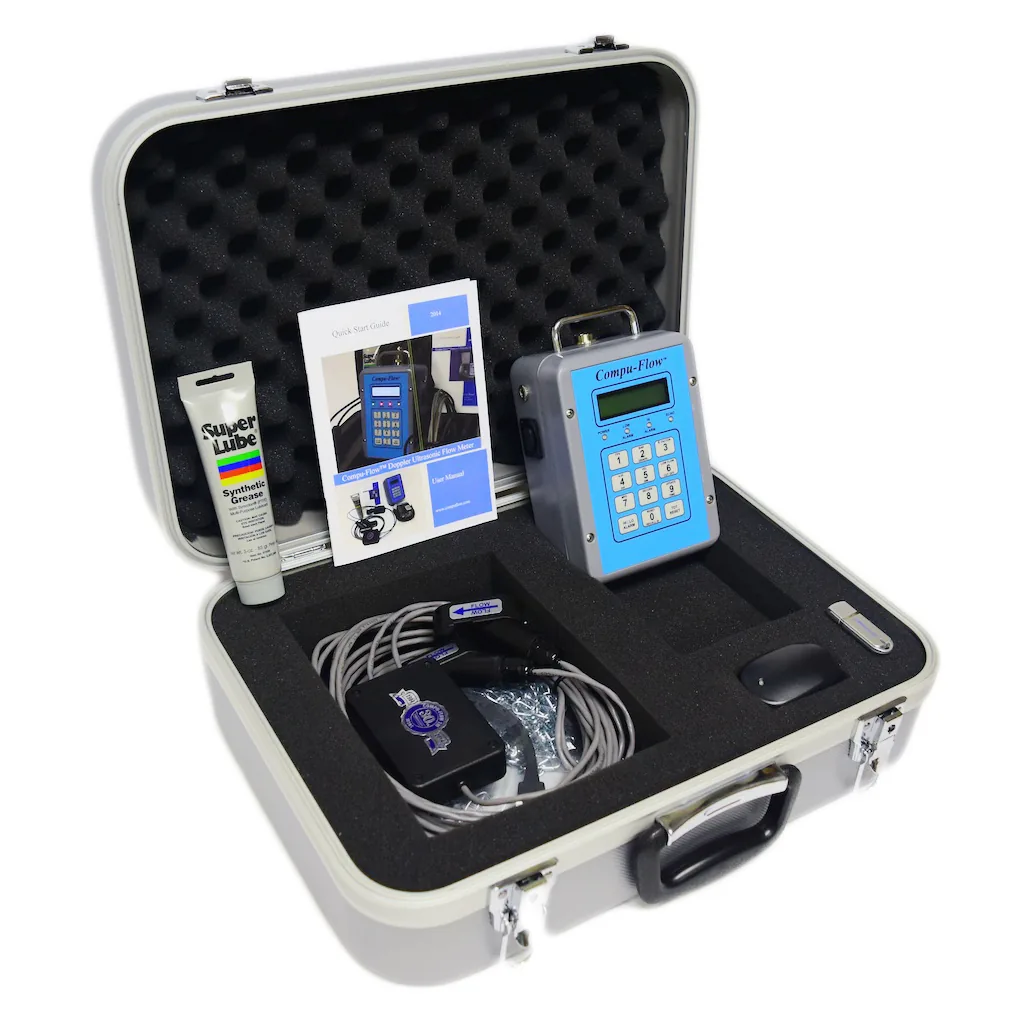
 Portable · Doppler
Compu-Flow C6 Portable Doppler Ultrasonic Flow Meter
Portable clamp-on Doppler flow meter for dirty liquids — sludge, slurry, raw wastewater, aerated streams.
SpecificationsA Doppler flow meter measures the frequency shift of sound reflected off particles and bubbles carried in the flow. It needs a dirty fluid. Sludge, slurry, raw wastewater, tailings — the streams that make a transit-time meter drop out are exactly what Doppler requires.
We compare eleven portable clamp-on ultrasonic flow meters side by side — including seven we do not sell — on pipe range, accuracy, transducer temperature, battery life and price, with transit-time and Doppler tabled separately and every figure taken from the manufacturer's datasheet. See the portable comparison →
Every other clamp-on meter in this catalog is transit-time, and transit-time needs an acoustically clean liquid. Load the fluid with suspended solids or entrained gas and the pulse scatters. The meter loses signal and drops out.
Doppler works on the opposite principle, and therefore has the opposite requirement. It fires sound into the fluid and measures the frequency shift of what reflects back off particles and bubbles being carried along by the flow. It needs reflectors.
So the fluids that make a transit-time meter useless — raw sewage, primary sludge, activated sludge, mine tailings, pulp stock, aerated effluent — are exactly the fluids a Doppler meter needs.
Put a Doppler meter on clean water and it reads nothing. Not inaccurately — nothing. There are no reflectors, so there is no signal. This is physics, not a defect, and no amount of configuration will change it.
The insensitivities are genuinely useful on a dirty process line. The Compu-Flow C6 is unaffected by changes in temperature, viscosity, specific gravity, or the speed of sound in the liquid. The liquid does not need to be electrically conductive — which is where a magnetic flow meter stops.
Consider what that eliminates. A sludge line whose solids loading changes hour to hour changes its density, its viscosity, and its speed of sound. A transit-time meter has to cope with all of it. A Doppler meter is measuring a frequency shift and simply does not notice.
1%, and the datasheet says “a function of flow profile.” That qualifier is doing real work.
Doppler measures the velocity of the reflectors, not of the fluid as a whole. In a pipe carrying slurry the reflectors are not evenly distributed — heavier solids concentrate low in the pipe, entrained gas rises. What the meter sees depends on where in that distribution its beam happens to be looking.
Doppler is excellent for trending, process control, alarming, totalizing, and relative change. It is not the instrument for custody transfer. If someone is being billed off the number, tell us and we will steer you elsewhere.
Portable · DopplerPortable clamp-on Doppler flow meter for dirty liquids — sludge, slurry, raw wastewater, aerated streams.
Specifications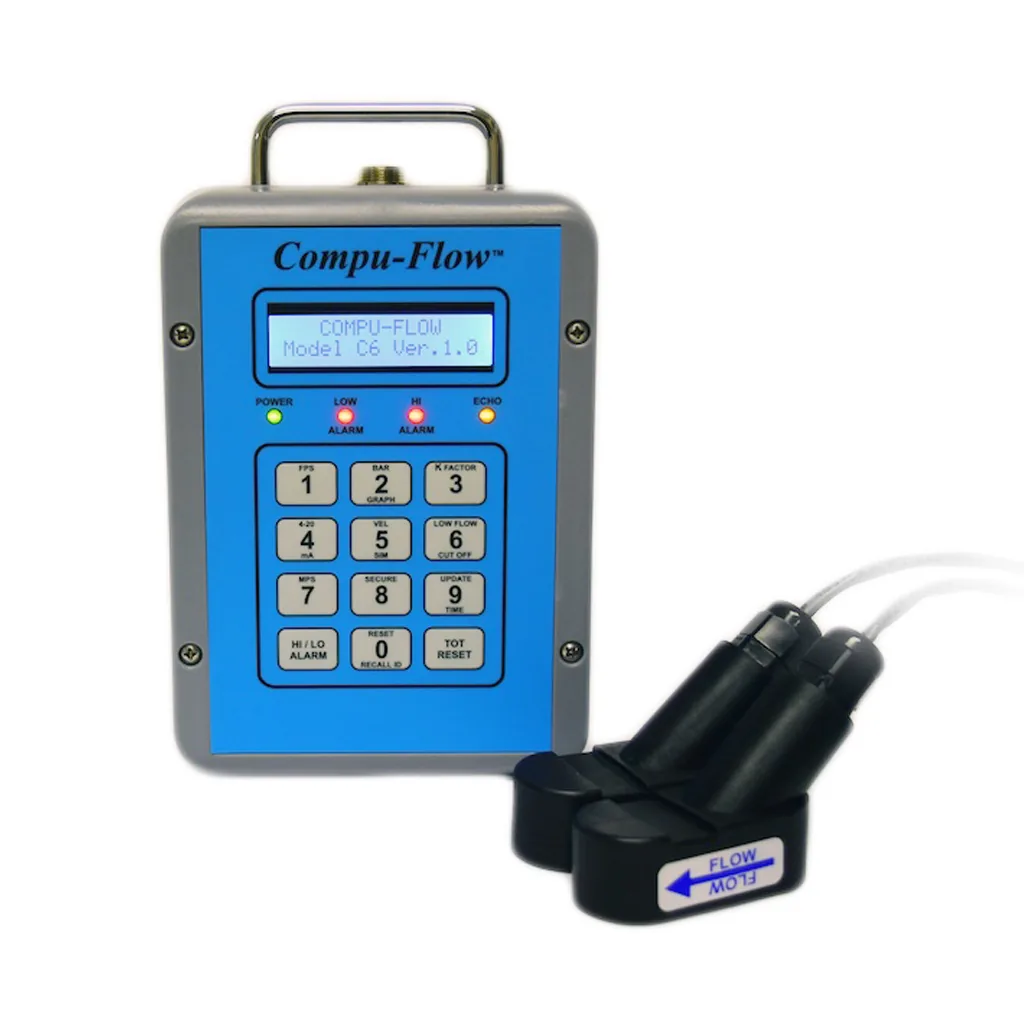 Fixed · Doppler
Wall-mounted permanent clamp-on Doppler flow meter for continuous monitoring of sludge, slurry, and raw wastewater.
SpecificationsConfirm the fluid is dirty all year. This is the question people skip and then regret. A wastewater line that runs clear after heavy rain dilution will take the meter dark exactly when something unusual is happening — which is exactly when you wanted the data. A slurry line during a wash-through cycle does the same.
If your fluid swings between clean and dirty, say so. It changes the recommendation, and it is much cheaper to tell us now.
Tell us what is in the pipe and whether it changes. That second question decides the answer, and it is the one people forget.
Request a quote