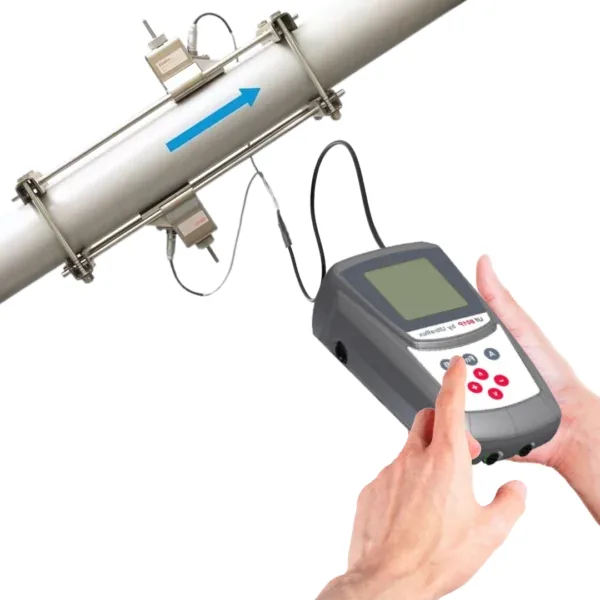
A portable transit-time clamp-on flow meter for water, corrosive chemicals, fuels and oils, with a built-in data logger and an optional BTU energy kit. Ready to measure in five minutes.
SKU SZ00U30020 · FROM $9,999
You run flow surveys, energy audits or meter verifications and the data has to hold up afterwards.
Ultraflux built this instrument around a specific person: the engineer who arrives at a plant, gets a number off a pipe, and then has to defend that number to someone who did not watch him take it. Everything about it follows from that.
The multi-parameter data logger is the headline. You are not writing a flow rate on a clipboard; you are logging flow, velocity, signal quality and gain over time, and exporting it. When someone asks six months later whether the reading was trustworthy, the diagnostic record answers.
Flow profile changes with Reynolds number. Laminar, transitional and fully turbulent flow have genuinely different velocity distributions across the pipe. An ultrasonic meter measures velocity along an acoustic path and infers the mean. If it assumes the wrong profile it applies the wrong correction factor and hands you a wrong number with total confidence. Automatic Reynolds detection is the instrument noticing which regime it is actually in.
Ultraflux publishes 1–2% typical, improving to 0.5% with field calibration. Both are true and the gap between them is the whole story of clamp-on measurement.
Accuracy is dominated by site conditions, not electronics. Pipe quality, internal scale, rust build-up, straight-run compliance and turbulence all disturb the flow profile, and therefore the relationship between velocity on the acoustic path and mean velocity in the pipe. The instrument is not guessing — it reports exactly what it sees on its path. If the path is not representative, the number is not representative. This is why we spend more time on where to put the transducers than on which instrument to buy.
With temperature inputs on supply and return, the UF801-P becomes a portable BTU meter. An energy audit goes from a two-instrument job to a one-instrument job: flow and delta-T from the same box, thermal energy calculated on board. For HVAC and district energy work that is the difference between a tool you carry and a cart you push.
| Measurement principle | Ultrasonic transit-time, clamp-on |
|---|---|
| Pipe size range | 0.5 in to 390 in (13 mm to 9,900 mm) |
| Accuracy | Typically 1–2%; up to ±0.5% with field calibration |
| Velocity range | Detects velocity as low as ±0.03 ft/s (0.009 m/s) |
| Fluids | Clean liquids with minor aeration under 5% — water, wastewater, corrosive chemicals, fuels, oils |
| Transducer temperature | Per transducer selection; consult application data |
| Wall thickness gauge | Optional |
| Data logging | Built-in multi-parameter logger |
| Energy / BTU | Yes — optional energy kit (BTU, kW, thermal audit) |
| Battery life | Up to two months using sleep function |
| Ingress protection | Field-rated case; consult datasheet |
| Instrument weight | Portable case format |
| Outputs | Logger download; energy kit I/O |
| Origin | France |
| Price | From $9,999 (published) |
Specifications transcribed from the manufacturer datasheet and subject to change. Confirm against the controlling document before specifying — Seztec will send it to you on request.
This instrument is specified into the following industries. Each page covers the specific measurement problems, the fluids involved, and what usually goes wrong.
The Ultraflux UF801-P measures clean liquids with aeration below 5% — water, wastewater, corrosive chemicals, fuels and oils. Because the transducers never touch the fluid, corrosive and aggressive chemicals are measured without any wetted-material compatibility question.
Above roughly 5% entrained gas or suspended solids, transit-time loses acoustic lock. For sludge, slurry and raw wastewater you want Doppler — see the Compu-Flow C6 Portable.
The Ultraflux UF801-P requires 10 pipe diameters of straight run upstream and 5 downstream. That is the standard clamp-on requirement and it exists so the flow profile is fully developed before the acoustic path crosses it.
Measuring closer than that produces a reading, but a reading of a skewed velocity profile with an uncertainty you cannot quantify. Use it for relative trending, note the condition in the report, and walk the line for a better location where you can.
Yes, with the optional energy kit. The Ultraflux UF801-P reports BTU, kilowatts and thermal energy for heating and cooling audits, combining the flow measurement with clamp-on temperature sensors on the supply and return.
The battery runs up to two months in sleep mode, which is what makes multi-week energy logging on a chilled water loop practical without site power.
Send us pipe size, pipe material, wall thickness, lining, fluid, and how much straight run you have. A Seztec application engineer will confirm the fit — or tell you it is the wrong instrument, which happens and which we would rather say before you buy.
Request a quote